Urethane casting
Urethane casting, also called vacuum casting, makes plastic parts by pouring urethane resin into a silicone mold formed around a master part. The mold costs far less than an injection mold, but each one makes only about 20 parts before it wears out.
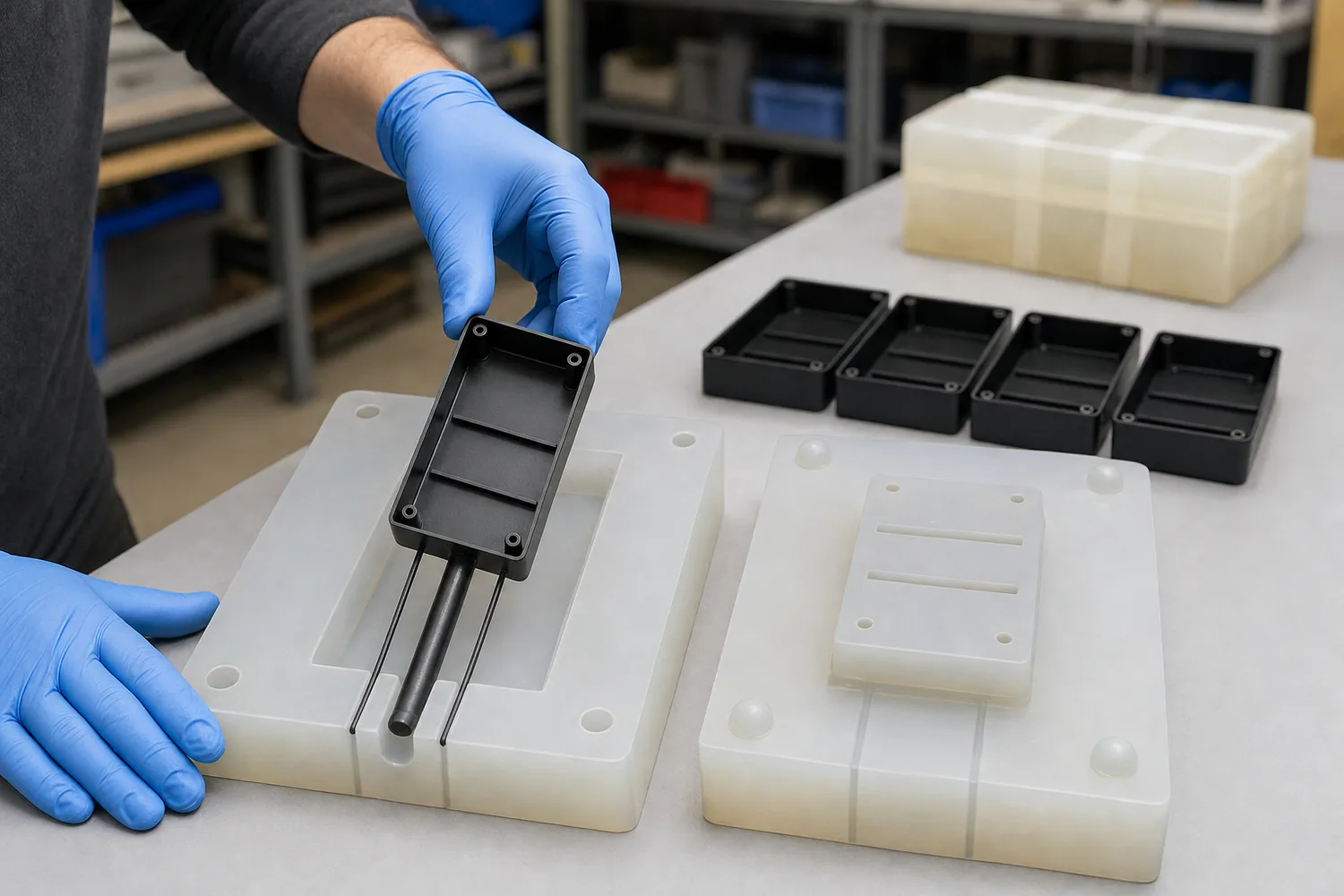
What the work includes
- Master part. The master is printed or machined, then finished by hand. The cast parts copy its surface.
- Silicone mold. Silicone is poured around the master under vacuum, then cut open along a parting line to take the master out. The cut leaves a faint line on each part. Each mold makes about 20 parts, fewer for complex shapes, so larger batches use several molds.
- Casting. Urethane resin is mixed, poured into the mold under vacuum and left to cure.
- Trimming and finishing. The pouring gate and vents are cut off. Parts are cast in color or painted.
What it makes and when to choose it
Enclosure halves and covers for beta units and early backers, and soft or clear parts.
Choose it for about 10 to 100 parts that have to look close to molded ones, such as beta units built while the mold is being made. With more molds it can reach a few hundred. The resins imitate ABS, polycarbonate, rubber or clear plastic, but they are not the production plastic, and light-colored or clear parts can yellow in sunlight. Plan on molded parts for safety testing. From a few hundred parts up, an aluminum mold usually costs less.
Common materials
| Material | Chosen for |
|---|---|
| ABS-like | Rigid enclosure parts and covers. The usual choice. |
| Flame-retardant ABS-like | Rigid parts that need a flame-retardant resin. A resin's UL 94 rating does not make the product listed. |
| Clear, acrylic-like | Windows, lens covers and light pipes. Clarity depends on a polished master. |
| PP-like | Tough, slightly flexible parts such as clips and snap fits. |
| Elastomers | Soft parts such as gaskets, grips and buttons, in a range of hardness. |
Finishes
Cast-in color matched closely, the texture of the master, painting for an exact color
Frequently asked questions
Is urethane casting cheaper than injection molding for a few hundred parts?
Usually not. Each silicone mold makes only about 20 parts before it wears out, so the molds keep costing as the quantity grows: 100 parts already need about five. Urethane casting usually fits about 10 to 100 parts. From a few hundred up, a bridge mold, usually aluminum, is the usual choice. Quote both at your real quantity and compare the total cost.
Can I use cast or machined parts for certification testing?
It depends on the test. A safety listing such as UL or ETL is tied to the listed grade of plastic and its wall thickness, so plan on molded parts in that grade. FCC emissions testing usually doesn't need the production plastic. For drop tests and snap fits, machined parts in the same family of plastic are a fair early check. Ask the test lab first.
What is bridge tooling?
Bridge tooling is an interim injection mold, usually aluminum and sometimes a softer steel, that makes real molded parts in the production plastic before, or instead of, a hardened steel mold. It costs less and is ready sooner. Aluminum molds commonly last thousands to tens of thousands of shots, so at a few hundred to a few thousand units it is often the production tool itself.
Other processes
We work fromSTEP · IGES · STL · Drawings · Photos
Tell us what you're building and how many you plan to make.
A real person on our team will reply with a first look at your production run and a few times to talk.
Free first look. We reply within two business days. Sending a request doesn't commit you to a project.